
Made of mass-produced micro quantum storage components, paving the way for large-scale industrialization
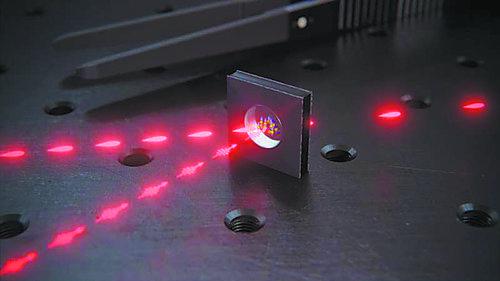
The glass chamber, which is only a few millimeters in size, is filled with rubidium atoms.
Like traditional networks, future quantum networks also require storage components. Researchers at the University of Basel in Switzerland have established an atomic based quantum storage device in a tiny glass chamber. In the future, such quantum memory can be mass-produced on wafers, which is expected to pave the way for large-scale industrialization. The research findings were published in the latest issue of the Physics Review Letters.
Photons are particularly suitable for transmitting quantum information. Photons can be used to send quantum information to satellites or quantum storage devices through optical cables. But the quantum mechanical state of photons must be stored as accurately as possible and then converted back to photons after a certain period of time.
Two years ago, researchers at the University of Basel proved that using rubidium atoms in a glass chamber can perform work well. But the glass room is handmade and measures a few centimeters in size. To be suitable for daily use, the glass chamber must be made smaller and suitable for mass production.
Researchers have explored some new methods to obtain glass chambers that are only a few millimeters in size. In order to have a sufficient number of rubidium atoms for quantum storage, they heated the glass chamber to 100 ℃ to increase the vapor pressure.
They also exposed atoms to a magnetic field of 1 Tesla (more than 10000 times stronger than the Earth's magnetic field). This changes the atomic energy level, thereby promoting the use of additional laser beams for quantum storage of photons. This method allows researchers to store photons for about 100 nanoseconds, during which free photons can propagate up to 30 meters.
Through this approach, researchers have for the first time constructed a miniature quantum memory for photons, which can produce approximately 1000 copies in parallel on a single wafer.
Researchers hope to store individual photons in miniature glass chambers in the near future. In addition, the glass chamber still needs to be optimized to store photons for as long as possible while maintaining its quantum state.
Information storage is a core component of modern information technology. With the development of human history, the medium of information storage is also constantly changing. Now it is hard to imagine what would happen in life without the Internet or mobile phone network. In the future, networks may use quantum technology, which will use quantum cryptography to achieve anti eavesdropping transmission of information and make quantum computer interconnection possible. But even quantum networks require information storage components. This time, scientists have developed such a storage component, which has pioneered the industry due to its mass-produced characteristics.