
Intel enters Arm chip field and catches up with TSMC to increase foundry market share
Intel hopes to become a global second-generation foundry by 2030 and hopes to become a resilient foundry that can mitigate supply chain disruptions caused by various issues such as geopolitics and war conflicts.
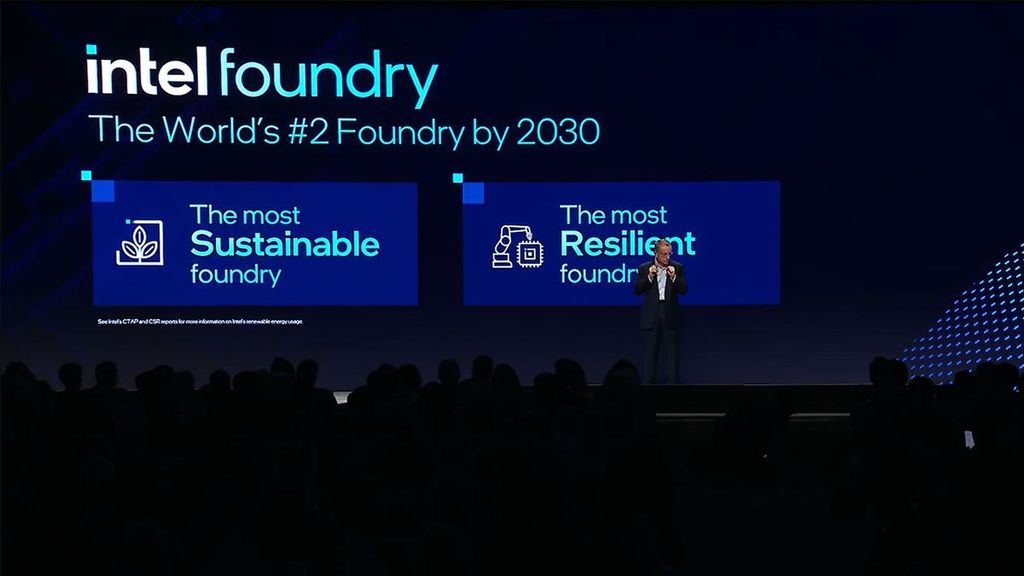
Intel will rebalance its semiconductor business and plans to place 50% of the industrial chain in the Americas/Europe and 50% in Asia.
Strengthen cooperation with Arm
Arm CEO Rene Hass attended the IFS event via a remote connection and said that the world seems to be moving away from the idea of exclusive hardware and instead hopes to build the most efficient chips for large companies like Microsoft or Faraday to Powered by artificial intelligence data centers.
Neoverse V series processors are positioned as performance optimization platforms. The latest V3 is the first processor design in this series to support the Neoverse CSS solution.
Neoverse V3 has a maximum single chip of 64 cores and a dual computing chip design that can provide a total of 128 cores. It supports HBM3 and CXL 3.0 and 2 sets of Die-to-Die interconnections. Compared with the previous V2. the general performance is improved by 9-16%.
Arm claims that compared to conventional performance improvements, Neoverse V3/N3’s performance improvements in AI data analysis are more obvious, reaching 84% and 196% respectively.
"Efficiency is especially important when you consider that these AI data centers require hundreds of megawatts or more of power," Rene Hass said.
Intel's 18A process node is impressive, and it appears that both Intel and Arm want to ensure that both companies benefit from the other's progress.